
The following experimental facilities are located at the Hydraulic laboratory of Politecnico di Milano (Fantoli)
E-NET
(download the inp file for Epanet and contact us)
(download the reduced inp file presented at Idra 2026)
.

An experimental distribution network developed with the support and collaboration of A2A Ciclo Idrico, based on the benchmark network proposed by Jowitt and Xu [1], used in more than 50 scientific publications for optimizing various aspects of a water distribution network, such as leakage reduction, valve placement, and energy recovery.
Goals:
• Be able to simulate a realistic water supply network;
• Experimentally verify the effectiveness of specific management strategies;
• Experimentally verify calibration procedures and optimization algorithm effectiveness;
• Test new technologies in a realistic context (TRL6) (valves, leak detection systems, energy recovery, control systems, reducers, meters, data management systems);
• Test AI methods for leak localization and other network optimization approaches;
• Provide an effectiveness technology tranfer hub for sudents, professional and technical staff.
With the advantage of reducing the cost of technological/modeling/management field tests and evaluating their effectiveness in a controlled environment such as a laboratory.
Main characteristics:
- 3 inverter driven pumps
- Diameter : 25 – 100 mm
- Roughness : 150
- Demand : 0-7 (L/s)
- Emitter coeff: 0.0008-0.008
- Total length : 1.1 km
E-Loop
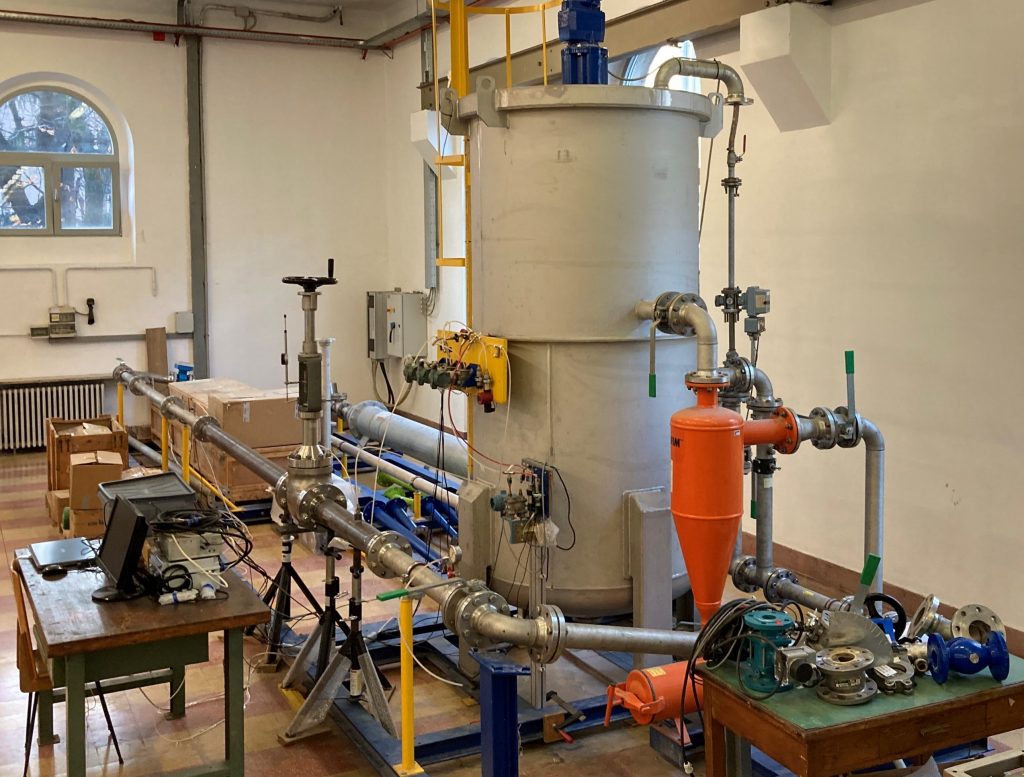
Hydraulic devices test loop under standard and critical operation conditions.
Performances parameters defined by the standard can be evaluated: IEC 60534, IEC 60193, ISA 72 01 01.
Main characteristics:
- Test line diameter: 25-150 mm
- Multistage pump (135 KW)
- Measurements: pressure, flowrate, temperature, acceleration, solid particle concentrtion
- Maximum flowrate 35 l/s
- Maximum pressure 25barg
- Critical conditions: cavitation /erosion
Air-Loop
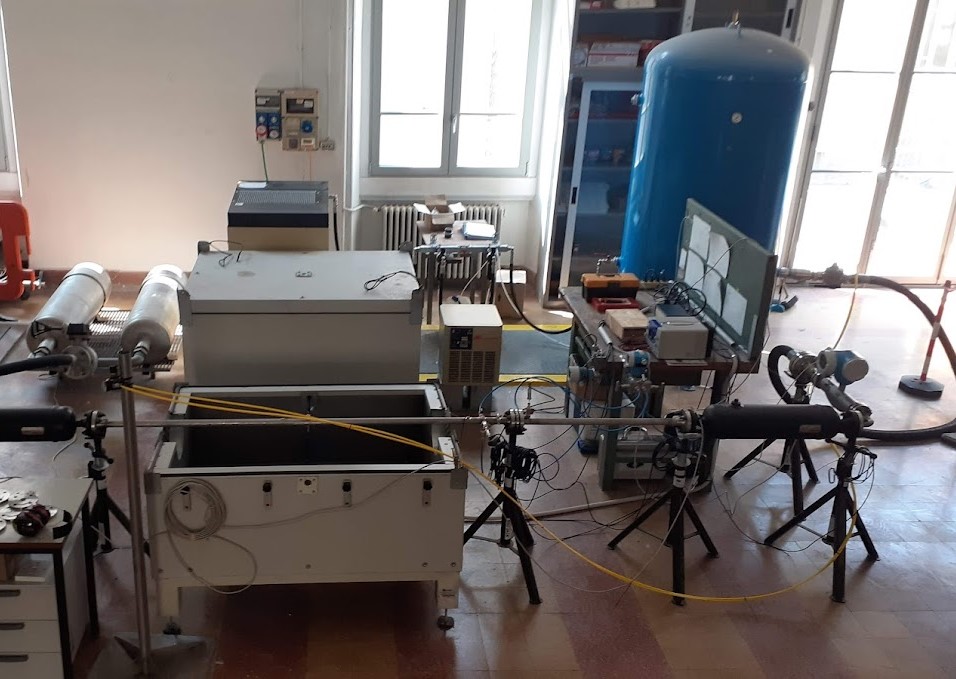
Plant to test flow control devices using dry air as a working fluid. Both fluid-dynamic and acoustic performances of the tested devices can be obtained as specified by the standard IEC 60534.
Main characteristics:
- Pipeline diameter: 25 mm
- Anechoic chamber
- Measurements: static pressure, mass flowrate, temperature, wall pipe pressure fluctuations, free-field acoustic pressure
- DN15 Coriolis flowmeter (accuracy 0.1%)
- Maximum inlet pressure: 10 barA
D.I.T. (Direct Impact Test)
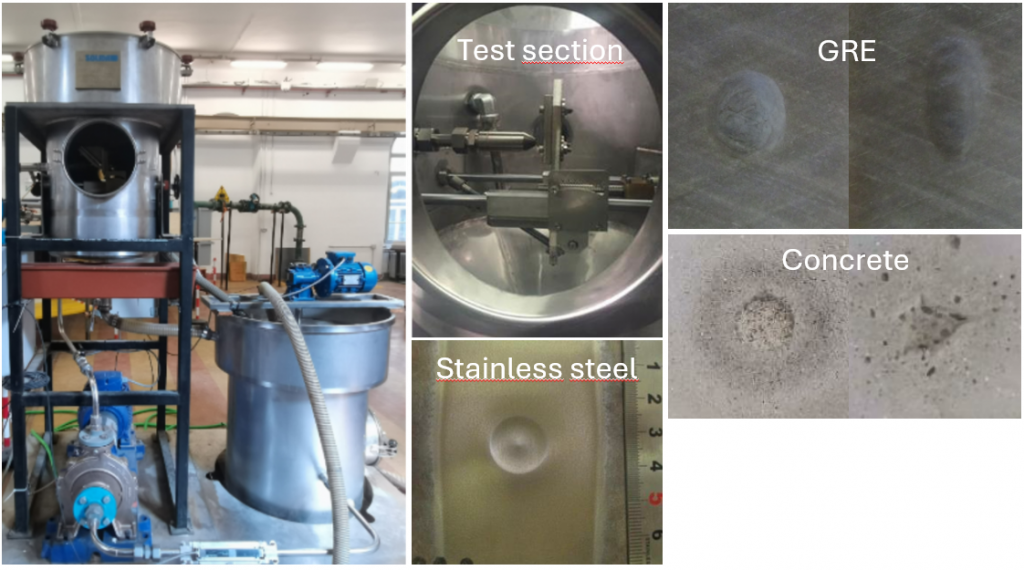
Particle erosion test plant, to characterize the resistance of materials to erosion by a particle-laden flow.
Main technical features:
- Nozzle exit diameter ≈ 8 mm
- Maximum jet velocity at nozzle exit ≈ 35 m/s
- Solid concentration ≈ 1% by volume
- Measured quantities: pressure upstream of the nozzle inlet, flowrate, mass of sample before and after the test
LowRe-Loop
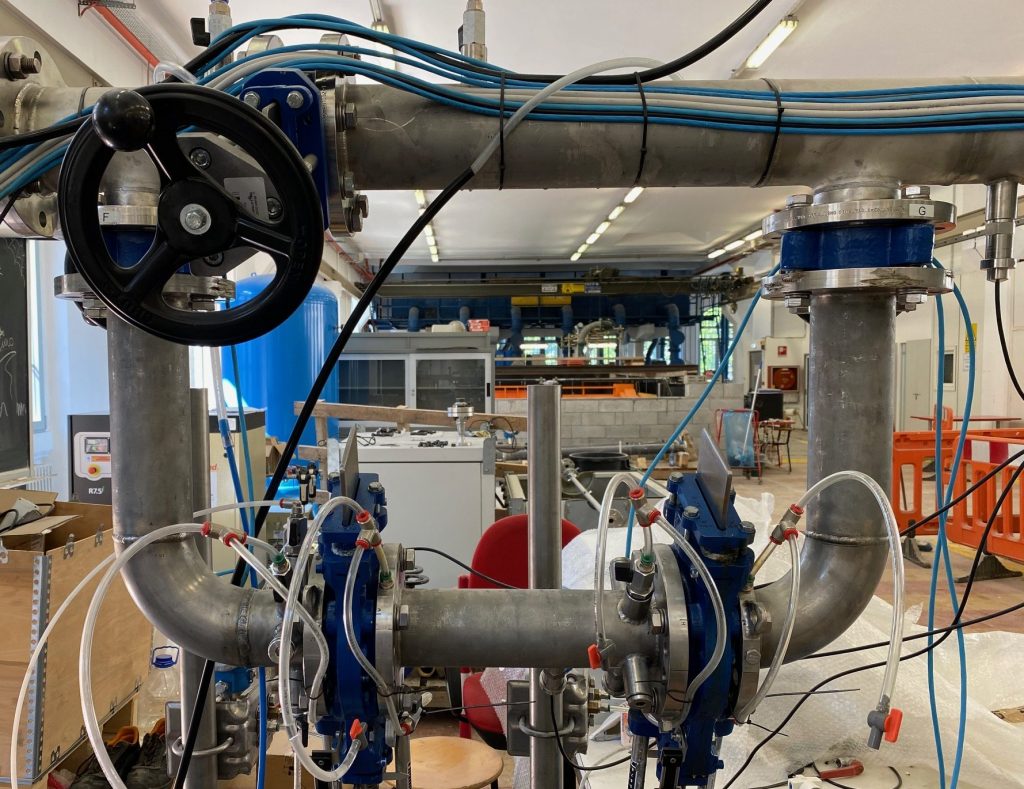
Low Reynolds Number tests loop. As operating fluid we use a variable mixture of water and glycerine (viscosity 40-60cSt) to provide test of hydraulic devices under low Reynolds number conditions.
Main characteristics:
- Pipeline diameter: 80 mm
- Measurements: density, pressure, flowrate, temperature
- DN80 Coriolis flowmeter (accuracy 0.1%)
- Maximum flowrate 22 l/s
- Maximum pressure 1.8 barg
Cavitation Plant
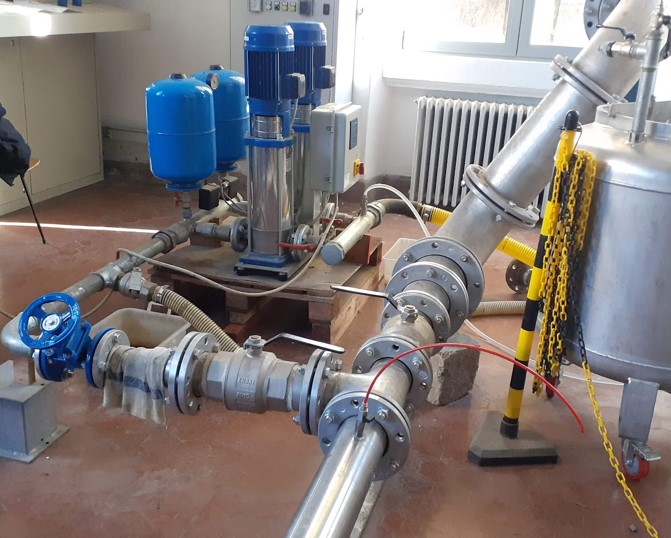
Hydraulic devices test plant under standard and cavitating conditions.
Main charachteristics:
- Diameter 25-100 mm
- Measurements: pressure, flowrate, temperature, acceleration, rpm, brake force
- Maximum flowrate 60 l/s
- Maximum inlet pressure 10 barg
- Minimum outlet pressure -0.5 barg